Shopify Raffle Drop vs. First-Come-First-Served: Which Model Sells Out Faster?
Every Shopify merchant running a limited product drop faces the same decision: should you raffle, or go first-come-first-served? Both models have real tradeoffs — but a third model outperforms both on conversion, loyalty, and organic reach.
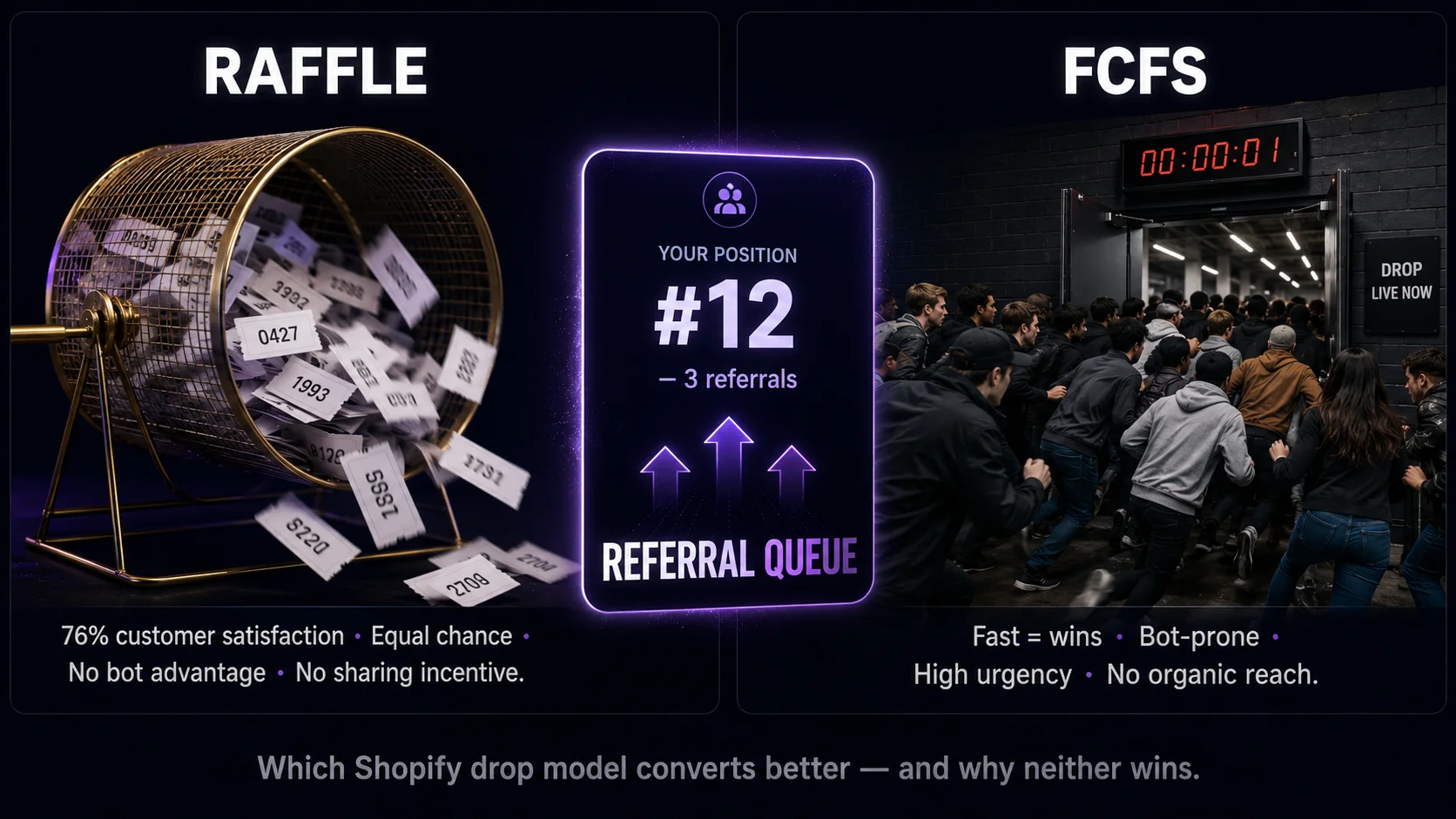
The two standard models — and what each one gets wrong
When you run a limited product drop on Shopify, you're choosing how to allocate a scarce resource. Most merchants default to one of two approaches that the industry has used for decades: first-come-first-served, or a random raffle. Both have a strong argument. Both have a significant flaw.
First-come-first-served (FCFS)
FCFS is how Supreme built its culture and how most streetwear brands still operate. You open the product at a set time, and whoever completes checkout first gets the inventory. It's simple, transparent, and creates genuine urgency — the countdown to drop time is real, and every second matters.
The problem is what happens at scale. When demand exceeds supply by more than 2–3x, FCFS becomes a technical competition rather than a customer experience. Bot operators — people who run automated checkout scripts — can complete a purchase in milliseconds. Without expensive bot-protection software, a brand with 2,000 genuinely interested customers can watch its inventory disappear to resellers before a real fan gets to the checkout page. Even with bot protection, FCFS rewards internet connection speed and checkout preparedness more than brand loyalty or genuine interest.
FCFS also generates zero pre-launch organic reach. There's nothing for customers to do before drop day except wait — no referral incentive, no sharing mechanic, no virality. Your pre-launch marketing is entirely on you.
Raffle drops
Raffles emerged as a direct response to FCFS's bot problem. You open entries for a set period, then randomly select winners. Nike moved its most limited sneaker releases to a raffle system via the SNKRS app after years of bot-driven frustration among its customer base. Many independent brands followed.
Raffles are fairer. Research from Queue-It found that 76% of drop customers report being very or extremely satisfied with their experience — and satisfaction is higher in raffle formats because the outcome feels fair even to losers. When you lose a FCFS drop to a bot, you're angry. When you lose a raffle, you accept it.
But raffles create their own problem: no urgency, and no sharing incentive. Entry windows are often days or weeks long, which kills the FOMO that makes drops exciting. And because your position doesn't change when you share, there's no reason to tell your friends about the drop. Raffle drops are entirely dependent on the merchant's own marketing budget for reach.
Sources: Queue-It Product Drop Research 2026; ReferralCandy Shopify Benchmark Report Q1 2026
Head-to-head: raffle vs. FCFS vs. referral queue
Here's how the three models compare across the dimensions that matter to Shopify merchants:
| Dimension | FCFS | Raffle | Referral Queue |
|---|---|---|---|
| Launch-day urgency | High | Low | High |
| Fairness perception | Low (bot-prone) | High | High (merit-based) |
| Pre-launch organic reach | None | None | Self-generating |
| Sharing incentive for customers | None | None | Strong (queue position) |
| Bot resistance | Low | High | High (no speed advantage) |
| Repeat-purchase / loyalty signal | Moderate | Moderate | Strong (referrers self-select) |
| Setup complexity | Low | Medium | Low (with EZDrop) |
| Marketing cost | High (paid only) | High (paid only) | Low (referral-driven) |
Why the referral queue model wins
A referral queue keeps what works from both competing models and fixes what doesn't.
From FCFS, it takes urgency. Your position in the queue is visible and can change — so there's a reason to act now rather than "whenever." The countdown timer is real. The slots are real. The competition is real.
From raffles, it takes fairness. You don't lose because someone has a faster checkout bot. You earn your position through two transparent inputs: how early you signed up, and how many friends you brought. Both are merit-based. Losers don't feel cheated — they know exactly what they'd need to do to improve their position next time.
What neither FCFS nor raffles have is what makes the referral queue model genuinely different: every participant becomes an active marketer. When someone's queue position improves every time a friend joins, they have a personal financial incentive to share your drop on every channel they use. Your customers do the pre-launch work for you.
ReferralCandy's benchmark research on over 3,200 Shopify stores found that waitlist members who received referral incentives converted to purchase at 3–5x the rate of cold email signups on launch day. The referral mechanic doesn't just grow your list — it pre-selects your most motivated buyers and places them at the front.
When FCFS still makes sense
FCFS is defensible for established brands with large, technically sophisticated audiences who expect the format — Supreme, Palace, certain sneaker brands. If your customer base has internalized the "fastest wins" culture as part of the brand experience, changing to a raffle or queue model can feel like a betrayal of the format.
It also works when inventory is very large relative to demand. If you have 500 units and expect 600 customers, the FCFS window will be long enough that bots aren't an issue and most genuinely interested buyers will get through.
When raffles make sense
Raffles are the right call when bot risk is unacceptably high and you can't afford enterprise-tier bot protection. If you're selling 20 units of a $500 item to an audience that includes resellers, a raffle is the only fair way to allocate. The long entry window also works if your product has broad reach — you want entries from people who saw the drop in a magazine, not just your email list.
Setting up a referral queue on Shopify in 5 minutes
EZDrop implements the referral queue model as a Shopify app with no code required. You create a drop, set a slot limit and release date, and drag the EZDrop block onto your product page in the Theme Editor. The app handles queue scoring, position updates, referral link generation, and launch-day emails automatically.
The scoring formula is: early-signup time bonus + (referrals × 50 points). Positions are recalculated in real-time as new entries come in. Each participant sees their current position and referral count on their confirmation page, giving them the information they need to share strategically.
The free plan covers 1 active drop and 500 entries — enough for most merchants to run a full test drop and see the referral mechanic in action before committing to a paid tier.
For more on the psychology behind why drops create more demand than standard launches, see Why Product Drops Outperform Standard Shopify Launches. For the complete pre-launch waitlist strategy, see How to Build a Viral Product Launch Waitlist on Shopify.
Run your first referral-queue drop
EZDrop is the Shopify waitlist app with a referral queue built in. Free plan — 1 active drop, 500 entries. No credit card required.
Install EZDrop free →Takes 5 minutes to set up · no code · works with any Shopify theme